
What we check
Scan settings
Test users, write probes, domain verification and how scans find your endpoints.
These settings live under Project settings. None are required, but each one unlocks more checks.
Test users#
Under Scan test tokens, add up to three test accounts. They're stored encrypted and never shown again.
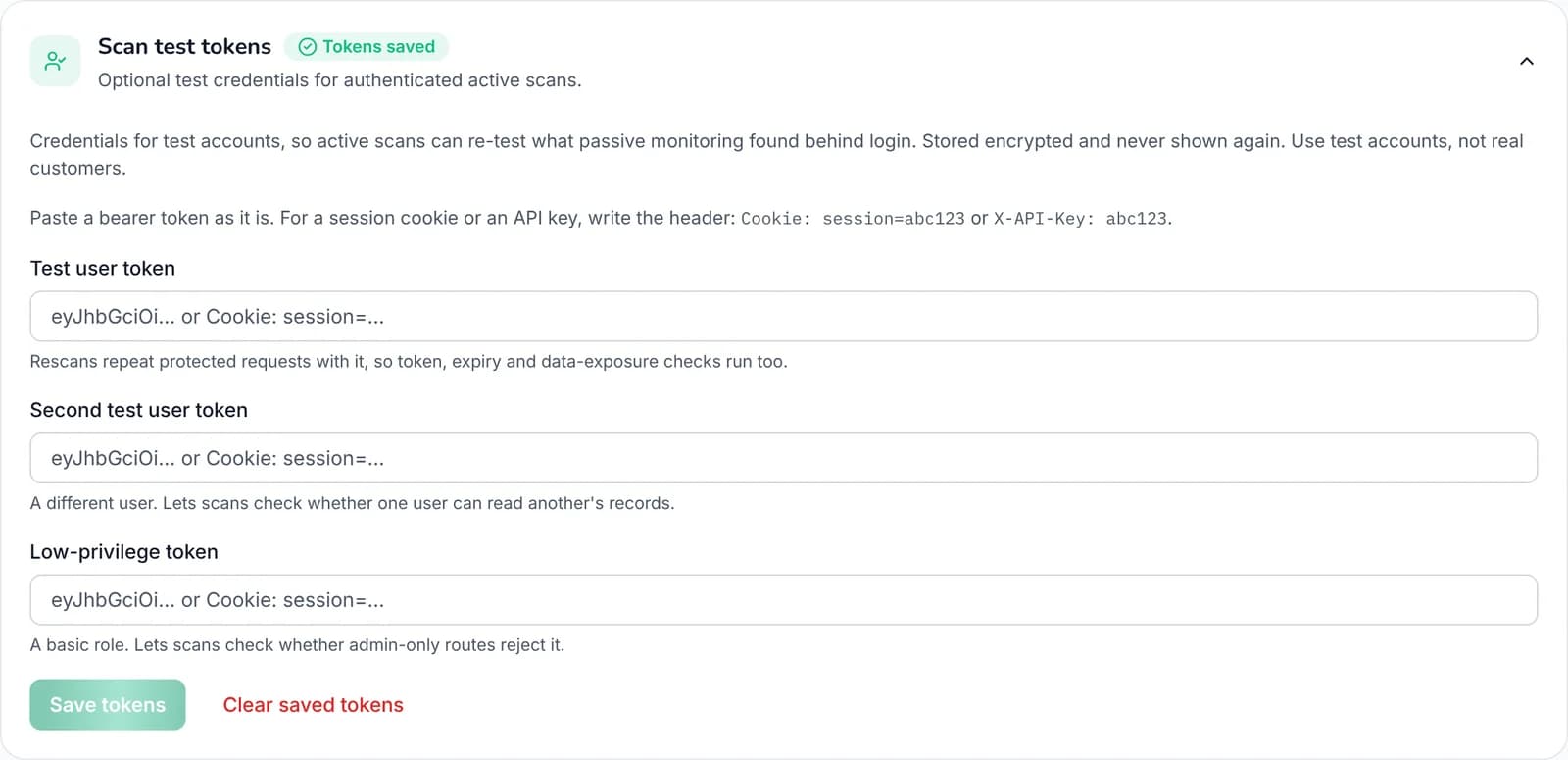 123
1Your main test user
2A second user, for cross-user checks
3A low-privilege user, for admin-route checks
| Add | Unlocks |
|---|---|
| A test user | Checks that need a signed-in user, and mass assignment |
| A second test user | Checking whether one user can read another's data |
| A low-privilege user | Checking whether normal users can reach admin routes |
Paste the credential in one of these forms:
eyJhbGciOiJIUzI1NiIs…      # a token, sent as "Authorization: Bearer …"
Cookie: session=abc123     # a session cookie
X-API-Key: k_live_7f3a… # any other headerWrite probes#
Some checks need to send POST, PUT or PATCH requests: mass assignment, bursts on sign-up and checkout, body size, webhook signatures, and SSRF in request bodies. Turn on write probes to allow them. They're only available on development and staging projects. DELETE is never sent.
Domain verification#
Active scans only run on domains you've proved you own, with a DNS TXT record. See Set up your first project for the steps.
- Changing your API's address to a different domain means verifying again. Changing only the path doesn't.
- Platform addresses like
*.up.railway.app,*.vercel.app,*.onrender.com,*.herokuapp.comand*.fly.devcan't be verified. Add a custom domain. - To check your record yourself:
dig +short TXT _auditgate.api.example.com @1.1.1.1
How scans find your endpoints#
Scans use the best source they have, in this order:
- Your connected repository. The most complete list.
- A published OpenAPI or Swagger document, in JSON, at a common path such as
/openapi.json,/swagger.json,/v3/api-docsor/api-docs. - Common REST paths such as
/usersand/orders/1, as a fallback.
The scan page says which one was used. If routes are missing, connect your repository or publish a JSON OpenAPI document.
Not supported yet#
- YAML OpenAPI documents.
- Uploading a spec file, or a custom spec address.